


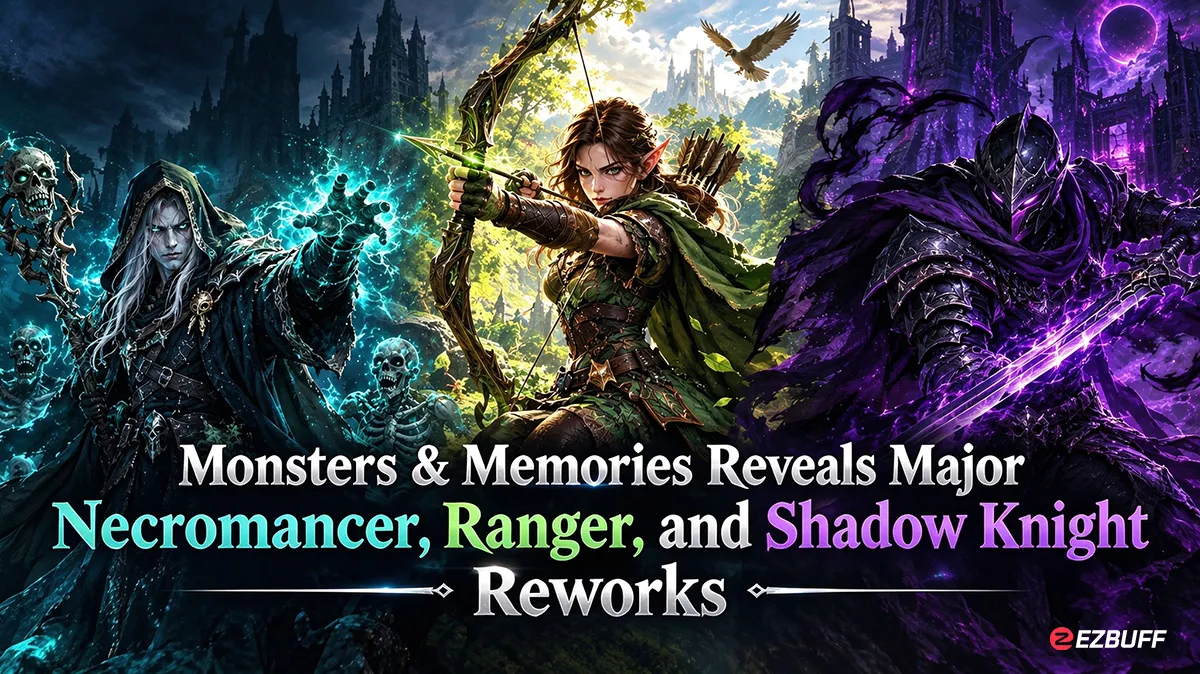
Monsters & Memories is preparing to give three of its classes a clearer combat identity, with redesigned abilities for the Necromancer, Ranger, and Shadow Knight alongside plans for a more flexible racial Trait system. The developer's September 29 update outlines how these changes will shape combat, group utility, and character progression as the MMORPG moves into Early Access.
According to the official announcement, the first implementation of the class reworks was scheduled for the October 1, 2026, Early Access launch build. The team also emphasized that class balance, fixes, and adjustments will continue as player feedback comes in.
The update covers more than individual spell changes. It also previews a broader Trait redesign intended to make race and background choices more meaningful without forcing players to remain locked into decisions made before they fully understand their chosen class.
Three Classes Receive More Distinct Combat Roles
The reworks focus on strengthening each class's central identity rather than giving every character a similar collection of abilities. Necromancers remain pet-focused damage dealers, Rangers gain a more physical combat style built around melee and ranged attacks, and Shadow Knights move toward a darker combination of soul manipulation, offensive melee combat, and defensive utility.
| Class | Core Combat Identity | Major Changes | Group Role |
|---|---|---|---|
| Necromancer | Pet-focused caster | Improved damage-over-time spells, level-scaling minions, and new Pacts | Ranged damage, pet support, and utility |
| Ranger | Mobile martial fighter | Dual-weapon combat, bow attacks, four stances, and wound care | Physical damage, off-tanking, tracking, and recovery |
| Shadow Knight | Dark melee fighter | Soul Servant, revised lifedrain spells, threat tools, and a defensive aura | Melee damage, survivability, and situational tanking |
These changes give players clearer reasons to choose one class over another. They also create different ways to contribute to a party, whether through sustained damage, battlefield control, recovery between encounters, or defensive support.
Necromancer Rework: Stronger Minions and More Flexible Damage
The Necromancer remains a ranged caster who relies on undead companions to hold enemies in place while damage-over-time effects gradually wear down targets. The revised kit focuses on improving these established mechanics and reducing abilities that overlap with other caster classes.
Damage-over-Time Spells Become More Effective
Three major spell lines remain at the center of the Necromancer's offensive toolkit:
- Deluge: Deals an initial burst of poison damage followed by lingering poison damage.
- Shadows: Inflicts Corruption damage over time and slows the target.
- Rot: Applies disease damage over time through the Rot Flesh, Rot Bones, and Rot Soul progression.
All three lines now deal additional upfront damage against undead enemies. This replaces the previous collection of specialized undead-damage spells, allowing Necromancers to use their regular damage toolkit against these targets.
The change simplifies combat decisions while preserving the class's emphasis on damage over time.
New Pacts Exchange Health for Power
The redesigned Pact system introduces a more direct trade-off between personal survivability and combat effectiveness. Activating these abilities reduces the Necromancer's maximum health in exchange for stronger minions or more efficient damage.
| Pact | Primary Effect | Tactical Benefit |
|---|---|---|
| Pact of Deathly Enduring | Improves a pet's Armor Class, maximum health, and health regeneration | Helps a minion withstand tougher encounters |
| Pact of Vampirism | Gives a pet a chance to drain life with melee attacks | Converts pet damage into healing for the group |
| Pact of Coldlight | Causes a pet to emit pale light | Provides utility in dark environments |
| Pact of Eldritch Quickening | Makes poison, Corruption, disease, and lifedrain damage-over-time spells tick faster | Delivers damage over a shorter period |
The Necromancer's three main pet families—Skeleton, Zombie, and Ghoul—also receive a more streamlined progression system. Minions now scale with the character's level between spell ranks, reducing the risk of a companion falling behind while the player waits to unlock a stronger summon.
Additional changes improve pet healing and utility. Burning Bones, a summoned burning skeleton, is available as a quest reward. However, the developer confirmed that collecting different pet types through exploration and temporarily raising fallen enemies as extra companions will arrive later rather than being included in the initial rework.
Ranger Rework: Melee, Archery, and Four Combat Stances
The Ranger is moving away from its previous combination of weapon attacks and a broad selection of elemental spells. Fire-based nukes, several elemental damage-over-time effects, and elemental weapon and arrow enchantments have been removed to make room for a more focused martial toolkit.
The redesigned class revolves around two attack styles: swordplay and marksmanship.
Swordplay and Marksmanship Work Together
Rangers begin their attack sequences with Opening Strike for melee combat or Leading Shot for ranged combat. These openers share a cooldown, so players must choose which approach best suits the situation. Using an opener unlocks a follow-up ability, after which the Ranger can begin another sequence.
| Ability | Combat Style | Effect |
|---|---|---|
| Finishing Blow | Melee | Attacks with both blades; requires a weapon in each hand |
| Hamstring Slice | Melee | Slows the target's movement |
| Rending Cut | Melee | Applies a bleeding wound that can become more severe with repeated hits |
| Swift Shot | Ranged | Delivers a powerful, accurate arrow |
| Maiming Shot | Ranged | Reduces the target's Dexterity and attack accuracy |
| Barbed Shot | Ranged | Applies a bleeding wound that can deepen with repeated hits |
| Tanglefoot | Crowd control | Snares multiple enemies in front of the Ranger |
The shared bleed mechanics encourage players to alternate between melee and ranged attacks. Under the appropriate stance, one attack can refresh the duration of a wound applied by the other, allowing skilled Rangers to maintain pressure for longer.
Four Stances Define the Ranger's Role
The stance system is one of the most significant changes to the class. Each stance modifies the Ranger's approach to combat or exploration.
- Warden Stance: Strengthens melee attacks and improves interactions between Hamstring Slice, Rending Cut, and an existing Barbed Shot bleed.
- Marksman Stance: Strengthens bow attacks, adds a snare to Maiming Shot, and allows Barbed Shot to refresh an existing Rending Cut bleed.
- Survivor Stance: Improves parry and Armor Class, offering limited off-tanking potential when combined with Taunt and Kick.
- Longstrider Stance: Increases outdoor movement speed for nearby party members, making it useful for traveling rather than fighting.
The developer cautions that Survivor Stance is not intended to replace a dedicated tank. Instead, it gives the Ranger a way to hold an enemy temporarily when a group needs additional defensive support.
Wound Care and Campfires Improve Group Recovery
Rangers also receive practical support abilities that fit their wilderness-survival theme. Healing Poultice restores an ally's health immediately and continues healing for a short period. Better versions have a higher chance of removing poison and disease.
The new Recuperate ability lets a group recover health and mana around a campfire after combat. Rangers can also create their own longer-lasting campfire through Hearth of the Ranger.
These tools make the Ranger more than a damage-focused character. Between tracking, foraging, outdoor movement buffs, concealment, and group recovery, the class offers useful benefits throughout an expedition.
Shadow Knight Rework: Soul Magic and Defensive Utility
The Shadow Knight retains its dark melee identity but is being separated more clearly from the Necromancer. Instead of relying on several shared undead summons, the class now binds a single lost soul to its service and uses lifedrain, debilitating magic, and threat-management abilities to survive close-range combat.
Soul Servant Replaces the Shared Pet System
Shadow Knights now summon a Soul Servant using a Soul Remnant obtained from enemies. The summon progresses through four ranks and scales with the character's level, although it remains somewhat less powerful than the dedicated pets of specialist summoning classes.
The pet also creates tactical choices beyond dealing damage. Shadow Knights can sacrifice it to create a Sacrificial Barrier or activate Wreath of Souls, which surrounds the character with damaging souls that retaliate against attackers.
Revised Melee Attacks and Soul-Based Spells
| Ability | Main Function | Combat Value |
|---|---|---|
| Shadow Strike | Extends the duration of the target's Shadows damage-over-time effects | Supports sustained offensive pressure |
| Siphoning Slash | Heals the Shadow Knight for 50% of damage dealt | Combines melee damage with self-sustain |
| Reave | Delivers a powerful two-handed weapon attack | Provides a heavier melee option |
| Goading Bash | Interrupts spellcasting and temporarily generates additional threat against blocked targets | Supports defensive control with a shield |
| Soulrend | Deals quick lifedrain damage | Provides a revised source of self-healing |
| Palpitation | Deals escalating damage while reducing enemy Agility | Combines damage with a debilitating effect |
| Grip of Shadow | Pulls an enemy toward the Shadow Knight and interrupts casting | Helps control enemy positioning |
Siphoning Slash has an additional purpose: landing it when an enemy is near death can siphon a Soul Remnant, which can then be used to summon a Soul Servant. This links the class's combat loop with its pet resource system.
Aura of the Unholy Becomes More Defensive
The Shadow Knight retains Aura of Vampirism, which gives group members a chance to trigger lifedrain attacks on melee hits. Aura of the Unholy, however, has been redesigned around survivability and threat generation.
The revised aura provides a modest Holy Resistance bonus to the group while increasing the Shadow Knight's threat generation and parry chance. When the character falls below 25% of maximum health, an Unholy Pact activates to reduce incoming damage, strengthen Soulrend's healing, and allow Grip of Agony to restore health equal to half the damage it deals while the pact is active.
This gives the Shadow Knight a more clearly defined emergency-defense mechanic without removing its aggressive playstyle.
Profane Study Is Planned for a Later Update
One of the most notable long-term additions is Profane Study, a planned system that will allow Shadow Knights to hunt and study powerful corrupted creatures. By tracking down these enemies, defeating them, and examining their remains, players will eventually be able to improve existing abilities or discover new forms of power.
The developer confirmed that Profane Study will not be available in the initial Early Access launch build. It should therefore be treated as a future progression feature rather than a current class mechanic.
Trait System Preview: Racial Choices Will Have Greater Impact
Alongside the class reworks, Monsters & Memories is redesigning its Trait system to make character creation more meaningful. The developer's September announcement described the changes as work in progress, with implementation planned during Early Access.
The system is intended to provide more customization while allowing players to revisit their decisions after gaining a better understanding of their characters.
| Trait Category | How It Works | Why It Matters |
|---|---|---|
| Racial Innates | Each race receives three innate traits, potentially including a vision type | Establishes racial identity and baseline utility |
| Background Traits | Players choose one of three backgrounds associated with their race | Introduces more substantial advantages and trade-offs |
| Personality Traits | Optional modifiers with small bonuses and penalties | Adds character flavor without requiring a specialization |
| Starting Boons | Lets players choose a starting item without attached stat bonuses or penalties | Separates starting equipment from character optimization |
| Progression Traits | Earned through quests as characters level up | Creates additional opportunities for long-term development |
The developer also intends to provide a way for players to reselect their Traits when the revamped system goes live. This is important because race and background decisions can be difficult to evaluate before players understand the strengths and limitations of their chosen class.
Racial Traits Offer Different Gameplay Advantages
The preview illustrates how racial identity can influence several aspects of gameplay rather than simply increasing one primary attribute.
Humans, for example, can benefit from faster skill progression and endurance-related bonuses. Wood Elves have wilderness-oriented advantages, including foraging and fishing bonuses. Deep Gnomes receive Ultravision and a bioluminescence ability, while Halflings can specialize in peaceful crafting and homesteading or choose more agile, commerce-oriented traits.
Other options emphasize different strengths. Gnomes have traits connected to tinkering and utility, Goblins feature pickpocketing and survival-oriented benefits, and Ogres can specialize in physical strength or other situational advantages. Dwarves combine practical crafting skills with traits related to endurance, mining, and defensive utility.
These examples remain subject to change. The developer explicitly stated that the listed values and some effects were still in development.
Vision Types and Progression Receive Additional Attention
Ultravision is expected to remain unchanged, while Infravision is being redesigned as an activatable ability. The development team also wants it to gain additional functionality, such as highlighting warm-blooded creatures.
Progression Traits will add another layer of customization. Some will require prerequisites, and others may be exclusive to specific races, class archetypes, or classes. They will be presented through quests, with Traits offered as rewards.
The system may even recognize objectives completed before a player receives the corresponding quest. For example, a character who has already defeated enough vermin could qualify for a related Trait when encountering the appropriate NPC.
This approach connects character progression more closely with exploration and activities in the game world.
What These Changes Mean for Early Access Players
The three class reworks suggest a deliberate effort to make Monsters & Memories' combat roles more recognizable. Necromancers gain stronger ties between health management and minion power, Rangers become more adaptable physical fighters, and Shadow Knights receive tools that combine offensive pressure with emergency defense.
The Trait redesign could have an equally important effect on long-term character development. Racial choices, background bonuses, optional personality modifiers, and progression rewards are intended to offer meaningful differences without permanently punishing players for early decisions.
For players preparing to enter the game, the practical takeaway is to choose a class based on its core combat loop and group responsibilities, then evaluate racial and background options in light of that role. Necromancers favor pet management and sustained spell damage; Rangers reward stance selection and the coordination of melee and ranged attacks; Shadow Knights combine close-range combat with lifedrain and threat control.
Players interested in the game's economy should also keep character progression in mind. Monsters & Memories Gold may be relevant to future equipment and resource planning, but the announcement does not establish new Gold farming routes, market changes, or class-specific Gold requirements. Players should avoid assuming that the class reworks directly alter the economy.
For readers following development through EZBUFF, the official class deep dives provide the most useful starting point for understanding the changes before investing time in a particular character. Anyone considering whether to Buy Monsters & Memories Gold should first confirm the game's current trading rules and available services rather than relying on assumptions drawn from this class update.
The initial class changes were scheduled for October 1, 2026, while the broader Trait overhaul and Profane Study remain subject to their respective implementation plans. As Early Access progresses, player feedback and further balance adjustments will help determine how these systems develop.
