


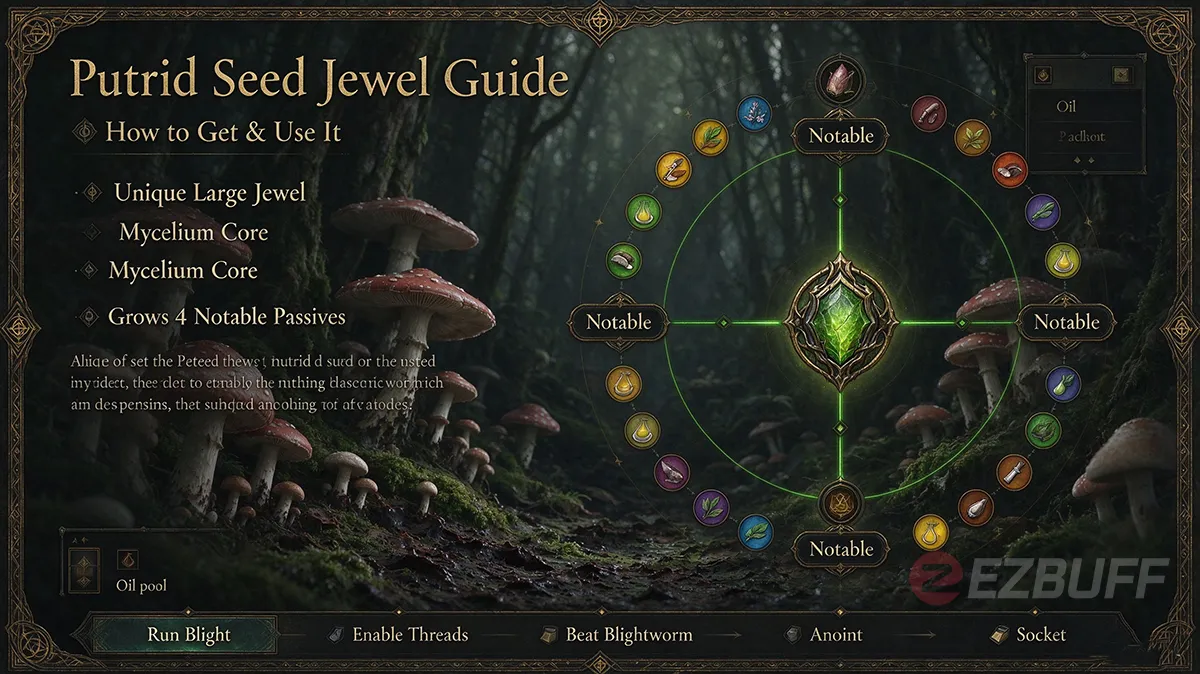
Grinding Gear Games has revealed more details about Putrid Seed, a new unique jewel arriving in Path of Exile: Covens of Umbra. This unusual jewel introduces a different approach to passive-tree customization, allowing players to grow four anointed passive skills directly onto their Passive Skill Tree.
Unlike traditional jewels, Putrid Seed uses Oils to determine its anointed passives, while its socket location influences the pattern of nodes generated around it. This combination of anointment choices and jewel placement could create new opportunities for build optimization, particularly for characters looking to access powerful Notable passives located far from their usual skill-tree routes.
In its official forum announcement, GGG also explained how players can obtain the jewel through Blight encounters, the role of Cassia in its anointing process, and an important clarification about its Historic Jewel classification. Here is everything players need to know about Putrid Seed before experimenting with this new mechanic.
What Is Putrid Seed? Unique Jewel Features Explained
Putrid Seed is a unique jewel built around a mycelium-based passive-tree mechanic. Its primary function is to grow four passive skills through anointment, allowing players to bring selected Notables into new positions on their Passive Skill Tree.
After anointing, the jewel can be placed in the same outer-tree sockets used by Cluster Jewels. Mycelial tendrils then spread from the socket, generating the Notable passives associated with the anointment.
However, the resulting layout is not identical for every socket. Different jewel positions produce different node patterns, although GGG confirms that all eligible sockets share the same total node count.
The following table summarizes the key details revealed in the official announcement.
| Item Detail | Description |
|---|---|
| Item Name | Putrid Seed |
| Item Type | Unique Jewel |
| Acquisition Source | Blight encounters with Threads applied |
| Required Material | Scrap of mycelial core |
| Anointing NPC | Cassia |
| Anointing Materials | Oils |
| Core Effect | Gains four anointed passive skills |
| Socket Requirement | Outer Passive Skill Tree sockets used by Cluster Jewels |
| Special Mechanic | Mycelial tendrils generate Notable passives on the tree |
| Socket Variation | Different sockets generate different node patterns |
| League | Path of Exile: Covens of Umbra |
The biggest attraction is its ability to bring valuable Notables closer to a character's existing passive-tree route. Instead of investing heavily in distant connecting nodes, players may be able to access useful passives through a strategically positioned Putrid Seed.
How to Get Putrid Seed: Blight Encounters and Effulgent Blightworm
Putrid Seed is connected to Blight content rather than ordinary monster drops. Players must participate in Blight encounters with Threads applied to gain a chance of encountering its exclusive miniboss, Effulgent Blightworm.
The acquisition process involves three main steps:
Step 1: Run Blight Encounters with Threads Applied
Players must first enter Blight encounters with the Threads modifier applied. This condition is essential for triggering the special encounter associated with Putrid Seed.
Step 2: Defeat Effulgent Blightworm
At the end of the Blight defense, players have a chance to be ambushed by the new Effulgent Blightworm miniboss. This encounter is not guaranteed, so repeated Blight runs may be necessary.
Step 3: Collect Scrap of Mycelial Core
Defeating Effulgent Blightworm can reward players with a scrap of mycelial core. This is the material players need to bring to Cassia to begin the jewel's anointing process.
| Acquisition Stage | Required Action | Expected Result |
|---|---|---|
| Blight Preparation | Apply Threads to Blight encounters | Enables the special encounter chance |
| Miniboss Encounter | Defeat Effulgent Blightworm | Chance to obtain the required material |
| Material Collection | Obtain scrap of mycelial core | Unlocks the next crafting step |
| Anointing | Visit Cassia and use Oils | Putrid Seed gains four anointed passives |
One important consideration is that neither the miniboss encounter nor its reward is guaranteed. Players should prepare for repeated Blight encounters rather than expecting to obtain the material in a single run.
How Putrid Seed Anointing Works: Oils and Four Passive Skills
Once players obtain the scrap of mycelial core, the next step is to bring it to Cassia.
Although Putrid Seed uses Oils, its anointment system differs from the traditional process players may already know. Instead of simply granting a passive effect through a conventional anointment, the mycelial material responds to the Oils used and gains four passive skills.
This makes Oil selection an important part of preparing the jewel for a particular build.
The basic relationship between the crafting components is straightforward:
| Component | Role in the Process | Importance |
|---|---|---|
| Scrap of Mycelial Core | Material brought to Cassia | Required to begin the process |
| Oils | Used during anointing | Influence the resulting passive skills |
| Cassia | Performs the anointing | Connects the crafting materials to the jewel |
| Putrid Seed | Unique jewel being anointed | Carries the four selected passive skills onto the tree |
Players should consider their build's main damage source, defensive requirements, and existing passive allocation before choosing Oils.
However, GGG's announcement does not provide a complete list of Oil combinations or guarantee specific Notable outcomes. Players should therefore avoid assuming that a particular combination will always produce four exact passives.
The most effective approach will be to compare available anointment possibilities and evaluate how the resulting Notables complement the rest of the build.
How Putrid Seed Changes the Passive Skill Tree
Putrid Seed's most distinctive feature appears after it has been anointed and equipped.
The jewel occupies an outer Passive Skill Tree socket that can also accommodate Cluster Jewels. Once placed, mycelial tendrils spread outward and generate the Notable passives associated with its anointment.
This creates a different way to approach passive-tree planning.
Normally, reaching a powerful Notable on the opposite side of the tree may require several connecting passive points. Such a route can become inefficient, particularly when a build needs those points for damage, survivability, or other essential bonuses.
Putrid Seed potentially offers an alternative by bringing selected Notables to the jewel's location.
Different Jewel Sockets Create Different Node Patterns
Socket selection is another important part of the mechanic.
GGG confirms that each eligible jewel socket around the tree generates a different pattern of nodes. However, all of these sockets share the same total node count.
This means that the choice of socket is not simply a matter of finding an available slot. Players should also consider how the generated nodes fit into their existing passive-tree layout.
| Socket Consideration | What Players Should Evaluate |
|---|---|
| Existing Passive Routes | Whether the generated Notables complement nearby allocated passives |
| Build Requirements | Whether the four anointed skills support the character's main strategy |
| Node Pattern | How the mycelial tendrils spread from the selected socket |
| Passive Investment | Whether the new layout offers an efficient alternative to distant Notable routes |
The exact value of each placement will depend on the character's build and the Notables generated through anointment.
Putrid Seed Build Potential: Advantages and Trade-Offs
Putrid Seed could become an interesting option for players who enjoy experimenting with unusual passive-tree configurations. Its main strength is the ability to reposition access to selected Notables without following their original routes.
However, the jewel also introduces several considerations that players should understand before building around it.
Potential Advantages
1. Access to Distant Notables
The jewel can bring powerful Notables from distant sections of the Passive Skill Tree to a more convenient location. This could help builds avoid inefficient passive-point routes.
2. More Passive-Tree Customization
Four anointed passive skills provide additional opportunities to experiment with different combinations. Players can explore alternatives that may not be practical with conventional passive allocation.
3. Flexible Socket Placement
Different outer-tree sockets generate different node patterns, giving players another layer of customization when planning their builds.
Potential Trade-Offs
1. Jewel Socket Competition
Putrid Seed uses the same type of sockets as Cluster Jewels. Equipping it therefore means choosing between this new mechanic and another potential use for that socket.
2. Anointment Uncertainty
The four passive skills are not freely selected one by one. Oils influence the result, so obtaining a combination that perfectly matches a specific build may require experimentation.
3. Passive-Tree Planning
A powerful group of Notables is not automatically useful for every character. Players still need to consider their existing routes, passive allocation, and overall build priorities.
Ultimately, Putrid Seed's value will depend on the strength of its resulting Notables and how efficiently they fit into a character's setup.
Important GGG Clarification: Putrid Seed Is Not a Historic Jewel
One important detail in the official announcement concerns the jewel's classification.
In the preview footage, Putrid Seed appeared as a Historic Jewel. However, Grinding Gear Games explicitly clarified that this will not be its classification when Covens of Umbra launches.
This clarification matters because players should not assume that Putrid Seed follows Historic Jewel rules based solely on the original footage.
The announcement also does not provide a complete explanation of every interaction involving passive-point allocation or other jewel restrictions. Those details should be confirmed through in-game testing or subsequent developer clarification rather than treated as established mechanics.
What Putrid Seed Means for Covens of Umbra Players
Putrid Seed introduces another layer of customization to Path of Exile's already complex Passive Skill Tree. Its combination of Blight-based acquisition, Oil-driven anointment, and socket-dependent node patterns gives players several decisions to consider before incorporating it into a build.
For players focused on endgame optimization, the most interesting possibility is the ability to access valuable Notables without committing to long and potentially inefficient passive-tree routes.
As Covens of Umbra launches, experimenting with different Oils and jewel positions will be essential to understanding which combinations provide the greatest benefits.
Players following equipment progression across the Path of Exile series can also explore Poe 2 items and build-related trading options. If you are researching where to buy Poe 2 items or comparing a Poe 2 item for sale, EZBUFF offers another destination to explore available game-item options. Keep in mind that Putrid Seed itself is a Path of Exile 1 item, not a Path of Exile 2 item.
Stay tuned to EZBUFF for more Path of Exile news, unique item breakdowns, build discussions, and endgame progression guides.
Putrid Seed FAQ
1. How do you obtain Putrid Seed in Path of Exile?
Players must run Blight encounters with Threads applied. Effulgent Blightworm may ambush them at the end of the defense, and defeating the miniboss can reward a scrap of mycelial core.
2. What does Putrid Seed do?
Putrid Seed gains four anointed passive skills through Cassia's Oil-based anointment process. When equipped, it generates the corresponding Notables on the Passive Skill Tree.
3. Does Putrid Seed work like a regular Cluster Jewel?
No. Although it uses the same outer-tree jewel sockets as Cluster Jewels, its unique mechanic involves mycelial tendrils that generate anointed Notables.
4. Do different Putrid Seed sockets have different effects?
Different eligible sockets generate different node patterns, but GGG confirms that they all share the same total node count.
5. Is Putrid Seed a Historic Jewel?
No. GGG clarified that the Historic Jewel appearance in the preview footage does not represent its classification at league launch.
6. Can players choose all four passive skills directly?
The official announcement explains that Oils influence the four passive skills gained through anointment. It does not describe a system that allows players to freely select each exact Notable.
