


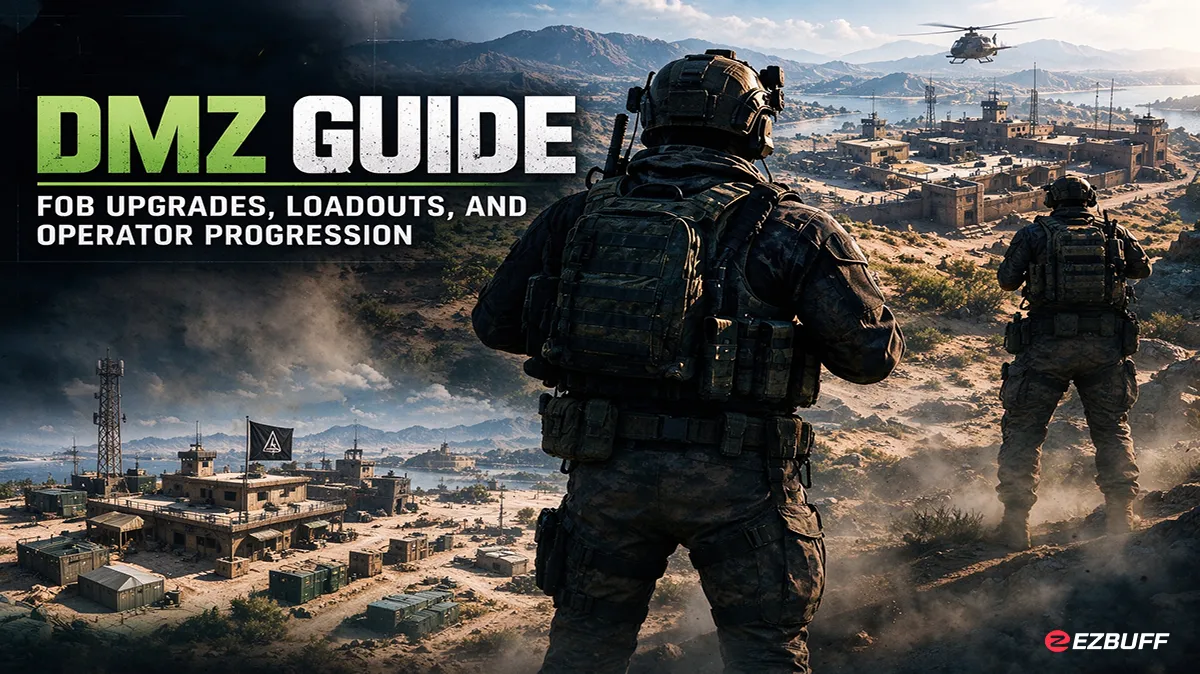
Call of Duty: Modern Warfare 4 is preparing to expand its extraction shooter experience with a detailed Forward Operating Base (FOB) system for DMZ. In an official guide published on October 9, 2026, Call of Duty outlined how players can manage Operators, store extracted loot, craft equipment, complete Orders, and prepare for their next deployment into the Hajin Exclusion Zone.
The FOB serves as the central hub between missions, connecting DMZ’s persistent progression systems with the risks and rewards of each deployment. With DMZ Early Access scheduled to begin on October 20 for eligible players who preorder the digital edition, understanding these systems ahead of time could give newcomers a more structured start.
The Forward Operating Base Connects Every DMZ Deployment
Unlike a mode built around isolated matches, DMZ encourages players to build momentum across repeated deployments. The FOB provides a place to organize equipment, review objectives, develop Operators, and unlock additional services as progression continues.
Players begin with several accessible stations, including Operators, Stash/Loadout, DMZ Orders, the Firing Range, and Survival Kits. More stations and upgrades become available through DMZ progression, gradually expanding the base's capabilities.
The Deploy station provides access to three main activities:
- Story Missions: Follow the developing conflict in Hajin and complete objectives for mission rewards.
- Dynamic Operations: Earn DMZ Cash, experience, and Supply Drops that improve in rarity as Operations are completed.
- Free Roam: Explore Hajin without committing to a specific mission.
These options support different approaches to extraction gameplay. Players who want clear objectives can focus on Story Missions, while those looking to accumulate resources or learn the map can use Dynamic Operations and Free Roam to develop their equipment and experience.
Stash and Loadout Management Determine What Players Can Keep
The Stash/Loadout station is one of the most important parts of the FOB because it separates stored assets from equipment carried into a deployment.
The Stash holds weapons, gear, consumables, keys, valuables, and crafting ingredients. Its initial capacity is 40 general items and 12 weapons, with weapons counted separately. The Loadout determines which weapons and supplies an Operator takes into Hajin.
Successful extraction allows players to bring back their carried equipment and collected loot. Failing to extract puts most carried items at risk, although items placed in Secure Slots are protected under the system's stated rules.
| Item or System | Main Function | Strategic Value |
| Stash | Stores collected weapons, gear, keys, and resources | Preserves useful items for future deployments |
| Loadout | Holds equipment selected for the next operation | Determines immediate combat and survival readiness |
| Backpack | Provides slots for items carried during deployment | Supports looting and resource collection |
| Secure Slots | Protect designated items from extraction failure | Reduces the risk of losing selected valuables |
| DMZ Cash | Funds purchases and is banked after successful extraction | Supports future equipment preparation |
| Mission Item Slot | Holds important items tied to missions or Dynamic Operations | Prevents critical objectives from competing for normal inventory space |
The distinction between the Stash and Loadout is particularly important for new players. Valuable equipment should not automatically be carried into every operation. Building a loadout around the objective, expected threats, and available resources can help reduce unnecessary losses.
The 3D Printer Links Loot Collection to Equipment Upgrades
The FOB's 3D Printer adds a crafting layer to DMZ's progression. Players collect resources and specific printer ingredients during deployments, then use them to craft equipment and unlock additional options as the system improves.
Looted items can contribute to resource pools, including Chemicals, Electronics, Metals, and Synthetics. These materials support crafting alongside the ingredients required by individual recipes.
The 3D Printer also helps players identify where desired items can be found, making it easier to plan resource-focused deployments rather than exploring without a clear objective.
| Resource or System | How It Is Used | Preparation Priority |
| Chemicals | Contribute to the resource pool used for crafting | Collect when pursuing recipes that require them |
| Electronics | Support crafting requirements | Keep useful quantities for planned upgrades |
| Metals | Form part of the general crafting resource pool | Gather during regular looting |
| Synthetics | Support crafting, including certain functional inventory items | Retain ingredients needed for specific recipes |
| 3D Printer recipes | Define which items can be crafted | Unlock and review recipes before specialized deployments |
| Printer upgrades | Expand available crafting options | Invest in upgrades that address equipment shortages |
The practical advantage is flexibility. Rather than depending entirely on whatever equipment happens to appear during a deployment, players can work toward repeatable ways to prepare for future operations.
Active Duty Operators Develop Through Traits and Dog Tags
Operator progression is another major part of the FOB system. Active Duty Operators can become stronger through successful deployments, with Dog Tag progression awarding Trait Points that can be invested in specialized playstyles.
The three Trait Trees are Warfighter, Scout, and Survivalist. Their names indicate distinct combat and utility approaches, allowing players to develop Operators around their preferred tactics. Operators can also earn permanent Prestige Traits tied to the individual character.
Players start with two Active Duty Operator slots and can unlock another through DMZ progression. Owners of the Modern Warfare 4 Vault Edition begin with three slots.
| Operator System | Purpose | Why It Matters |
| Active Duty slots | Maintain multiple Operators for deployment | Allows players to prepare different characters for different needs |
| Dog Tags | Track an Operator's progression and improve in quality | Generate Trait Points as progression advances |
| Trait Points | Improve the selected Operator through Trait Trees | Support specialized playstyles |
| Warfighter | One of the three available Trait Trees | Provides a distinct route for Operator development |
| Scout | One of the three available Trait Trees | Supports an alternative specialization |
| Survivalist | One of the three available Trait Trees | Offers another route for building an Operator |
| Permanent Prestige Traits | Provide lasting traits tied to an individual Operator | Reward continued investment in a specific character |
Because Operators develop individually, maintaining more than one can offer tactical flexibility. Players can build a character for resource gathering, another for more dangerous engagements, or simply keep a backup ready when their preferred Operator needs a different approach.
DMZ Orders and the Vendor Support Long-Term Progression
DMZ Orders provide a persistent list of objectives, rewards, and progression tasks. Completing them can grant resources, loot, and cash while guiding players through the mode's systems and narrative.
The Vendor, which unlocks at DMZ Level 5, offers a faster way to acquire weapons and equipment. Its available gear improves as players progress, while additional upgrades can expand its selection. Because the inventory refreshes periodically, players will need to consider when to spend their DMZ Cash and when to save it for a more valuable purchase.
DMZ also features its own progression track spanning 70 levels. Story Missions, Dynamic Operations, Side Ops, and other deployment activities contribute DMZ XP. This experience also contributes to the main player progression system, but multiplayer and Call of Duty: Warzone XP do not advance DMZ levels. Importantly, DMZ XP earned during a deployment still counts even if the player fails to extract.
This creates a progression loop in which each operation can contribute something, whether that means extracted equipment, crafting materials, mission rewards, or experience.
Preparing for DMZ: A Practical Pre-Deployment Checklist
Before entering Hajin, players should check their equipment and objectives rather than relying on a single default loadout.
- Review current DMZ Orders and choose an objective that fits the squad's equipment.
- Equip a weapon, a Plate Carrier, a Backpack, and medical supplies such as a Medkit.
- Check whether the selected Operator's Traits suit the planned deployment.
- Leave enough inventory space for resources, mission items, and valuable loot.
- Use the Firing Range to test weapons and optics before committing to a dangerous operation.
- Consider Squad Fill if additional teammates are needed; the feature can match a player with two allied players.
- Review the extraction plan and avoid treating every encounter as a fight that must be taken.
Players without sufficient funds or crafting options can use the Free Loadout option during deployment preparation. Extracting successfully allows them to keep those Loadout items, making it a useful way to build up reserves without committing their best stored equipment.
What the FOB Means for Modern Warfare 4's DMZ
The FOB is more than a menu for selecting weapons. It connects extraction, crafting, mission objectives, Operator development, and long-term progression into one persistent system. Players who manage their resources carefully can gradually expand their options and prepare more effectively for the threats found across Hajin.
For players researching Call of Duty Modern Warfare 4 Bot Lobbies, it is worth distinguishing conventional multiplayer bot matches from DMZ's extraction-based PvPvE gameplay. The official FOB guide describes a mode built around AI enemies, rival Operators, loot, objectives, and extraction rather than confirming a dedicated bot-lobby feature for DMZ. Players looking to Buy Call of Duty Modern Warfare 4 Bot Lobbies should therefore verify the specific mode and service being offered instead of assuming it applies to DMZ.
With DMZ Early Access scheduled for October 20, the FOB systems offer players a useful starting point for understanding how preparation and progression will shape each deployment. Learning how to protect valuable equipment, prioritize crafting materials, and develop Operators could prove just as important as winning individual firefights.
