


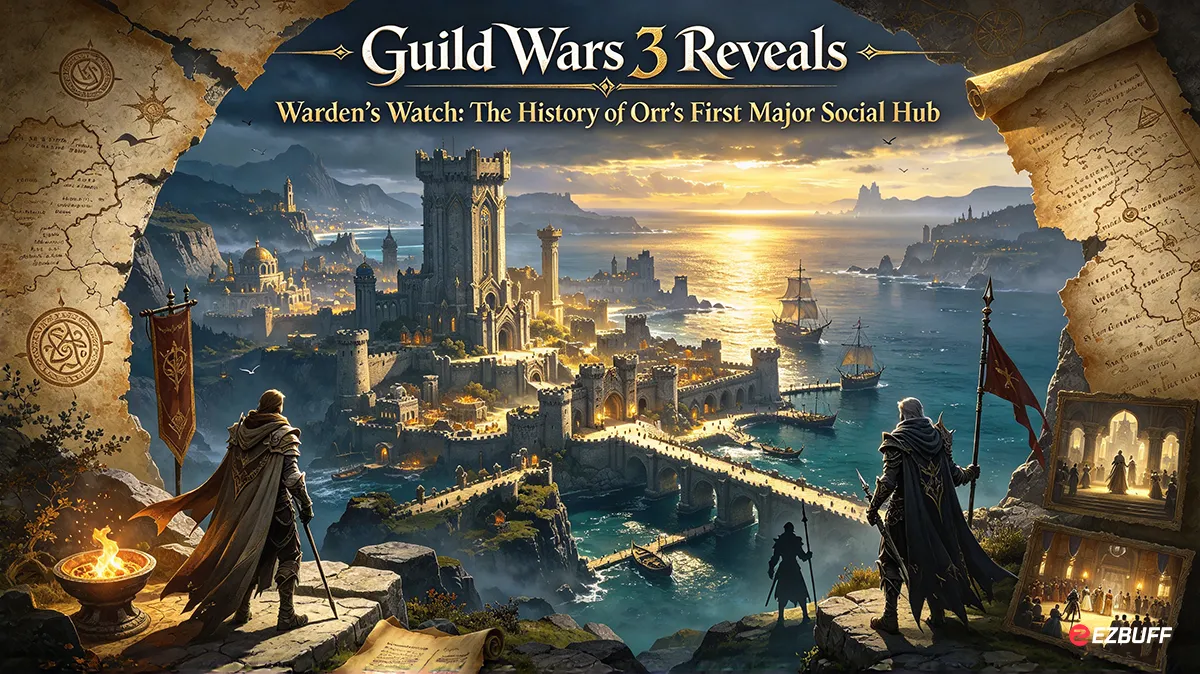
ArenaNet has offered a deeper look at Warden’s Watch, one of the oldest settlements in Orr and the first major player social hub revealed for Guild Wars 3. Published on October 15, 2026, the developer’s latest lore feature explores the settlement’s origins, its connection to the Order of the Vael, and the political tensions threatening its future.
Built around an ancient Forgotten tower, Warden’s Watch has grown from a refuge established after a magical catastrophe into a functioning town filled with guild facilities, workshops, trading activity, and religious institutions. However, the Vaelwardens who protect it are losing influence, while rival guilds are becoming increasingly assertive.
The reveal provides important context for Guild Wars 3’s worldbuilding, showing how historical disasters, competing organizations, and everyday community life shape the frontier of Orr.
Orr Thulon’s Death Explains Why Warden’s Watch Exists
The history of Warden’s Watch begins with the death of Orr Thulon, a colossal aerial spirit that dominated Orr for millennia. For those who revered the Vael, the ancient represented the region’s extraordinary magical richness and the stability of its natural order.
That belief collapsed in 205 BE, shortly after humanity arrived in Orr. A catastrophic battle over Tughra Basin ended with Orr Thulon being struck down. The impact devastated the surrounding land, creating a vast, barren expanse stripped of natural and magical life.
The aftermath was equally destructive. A torrent of stored magic erupted from Orr Thulon’s mask, leaving uncontrolled magical forces to sweep across the region in relentless sandstorms.
The ancient’s allies responded by seeking help to heal the wounded land. With Melandru’s assistance, they began restoring the damaged environment and received permission to use an abandoned Forgotten tower west of the catastrophe’s epicenter.
That tower became the foundation of Warden’s Watch and the Order of the Vael’s enduring mission.
The settlement therefore represents more than a convenient place for adventurers to gather. Its existence is a reminder of the disaster that shaped the Vaelwardens and the responsibility they accepted to protect Orr’s spirits and magical ecosystem.
How Warden’s Watch Is Organized: From Ancient Tower to Growing Town
One of the most interesting details in the reveal is the settlement’s physical layout. Warden’s Watch has expanded outward over generations, with each successive layer representing a different period in its history.
The central Forgotten tower remains the oldest structure. Around it are the Vaelwardens’ original facilities, followed by residential and commercial areas established by later settlers. The newest developments occupy the town’s outer ring.
This design gives the settlement a visible historical progression rather than presenting it as a collection of unrelated buildings.
| Area or facility | Main purpose | Lore significance |
|---|---|---|
| Forgotten tower | Central landmark and original foundation | Its builders and original purpose remain mysterious |
| Vaelwardens headquarters | Guild administration and coordination with Arah | Connects the order to Orr’s wider political structure |
| Quartermasters and artificing stations | Maintaining and refining signets and weapons | Reflects the order’s specialized magical craftsmanship |
| Tavern | Rest and social gathering for returning wardens | Establishes the settlement as a home for adventurers |
| Homesteads and workshops | Housing and work for human, asura, and kodan settlers | Shows how the original outpost developed into a community |
| Abandoned Mavenwright kiln | Former industrial workshop, now repurposed | Reflects the breakdown in relations between rival guilds |
| Outer guild facilities and Church of the Six temple | Support other guilds, religious activity, and dispute resolution | Demonstrates Warden’s Watch’s growing importance to greater Orr |
Source: ArenaNet’s “Discover Warden’s Watch,” published October 15, 2026.
For players interested in exploration and environmental storytelling, this layered design offers a useful way to understand the settlement. Moving from the center toward the outskirts is effectively a journey through the town’s development, from its origins as a refuge to its current role as a regional hub.
The reveal also establishes several potential points of interest for future exploration, including the mysterious tower, the Vaelwardens’ crafting facilities, the repurposed kiln, and the temple overlooking the settlement’s political life.
The Vaelwardens and Mavenwrights: A Conflict Reshaping the Settlement
Warden’s Watch may be a place of rest and resupply, but it is far from peaceful.
The Order of the Vael, whose members are known as Vaelwardens, was founded to protect Orr’s magical spirits and the lands they inhabit. Its traditions emphasize stewardship, the defense of vulnerable communities, and the responsible use of magical power.
The Mavenwrights represent a sharply different approach. This rival guild of builders and industrialists sees Orr’s magical resources as an opportunity to transform society through engineering, production, and the exploitation of the Vael.
Their rivalry has intensified, and the consequences are now visible inside Warden’s Watch.
| Faction or group | Primary role | Current position |
|---|---|---|
| Order of the Vael | Protects the Vael and the magical wilds of Orr | Losing members and struggling to preserve its influence |
| Mavenwrights | Pursues industrial development and the use of magical resources | Increasingly aggressive; its members are barred from entering Warden’s Watch |
| Zaishen guards | Help maintain security around the settlement | Enforce the exclusion of Mavenwrights |
| Other guilds | Represent trade, commerce, and other regional interests | Becoming more organized and influential |
| Church of the Six | Provides religious and political connections to Arah | Offers a local channel for settling disputes between guilds |
The Accords prohibit armed conflict within Warden’s Watch, but the growing hostility between the Vaelwardens and Mavenwrights has led to a practical solution: the rival guild is no longer allowed inside.
The abandoned kiln is a particularly telling detail. Once operated by the Mavenwrights, it has been repurposed since their fall from favor. It shows how political tensions can change not only who controls a settlement but also how its physical spaces are used.
For Guild Wars 3, this conflict establishes a central narrative question: how should the people of Orr balance magical preservation with economic development and technological progress? Neither the settlement’s growing commercial interests nor the Vaelwardens’ traditional mission can be understood in isolation from that debate.
The Church of the Six Signals Warden’s Watch’s Growing Importance
Another significant development is the presence of a temple belonging to the Church of the Six on the settlement’s outer ring.
Although the temple represents the human pantheon, its role extends beyond worship. It also acts as a political and clerical connection to Arah, the seat of the gods and a major center of governance in Orr.
For ordinary residents who have neither a place on the High Council nor direct access to Arah, the clergy provide an important intermediary. The temples also serve as the first venue for resolving disputes between guilds before those disagreements reach the council.
Its presence in Warden’s Watch is therefore a sign of the settlement’s changing status. Tughra Basin was historically a rural region distant from Arah’s attention. The establishment of a temple suggests that the area is becoming more integrated into the political and religious affairs of greater Orr.
This development also introduces another layer of tension. As the town gains influence, the Vaelwardens must share responsibility with institutions and guilds whose priorities may not always align with their own.
The question is no longer simply how to protect the spirits. It is also who gets to decide the future of the land they inhabit.
What Warden’s Watch Reveals About Guild Wars 3’s Worldbuilding
Warden’s Watch illustrates how Guild Wars 3 is establishing its setting through the relationships between history, institutions, and everyday life.
Rather than focusing exclusively on powerful characters or major battles, the reveal examines how a settlement functions. Farmers and traders need stability. Guilds need facilities and influence. Religious institutions mediate disputes. Guardians must balance their ideals against dwindling resources and changing public attitudes.
The result is a settlement with competing needs and a history that continues to shape its present.
The gradual decline of the Vaelwardens is especially important. Their order was created in response to a catastrophe that permanently damaged Orr, yet the settlement they founded has grown into a community whose residents increasingly depend on commercial and political institutions beyond the order’s control.
The same development that has helped Warden’s Watch flourish may also weaken the institution responsible for its founding.
ArenaNet has also confirmed that Guild Wars 3’s beta opportunities are expected to begin in Fall 2027. The Warden’s Watch feature is a lore reveal rather than a detailed gameplay announcement, so specific activities, rewards, vendors, and economic systems associated with the settlement have not been established in this article.
What This Means for Players Interested in Guild Wars 3 Gold
Although the latest reveal focuses on lore and worldbuilding, it provides useful context for players thinking ahead to the game’s potential economy.
Warden’s Watch is described as a place where guilds rest, resupply, and exchange news, while quartermasters, artificing stations, workshops, and trading activity support the wider community. These details establish the settlement as a plausible center of player activity, but they do not confirm specific gold-making methods or marketplace mechanics.
For players researching Guild Wars 3 Gold, it is worth distinguishing between what ArenaNet has confirmed and what remains speculative.
| Confirmed detail | Potential relevance to the economy | What remains unconfirmed |
|---|---|---|
| Guilds gather at Warden’s Watch | A social hub could become important to player interaction | Whether it will host a player marketplace |
| Quartermasters and artificing stations maintain signets and weapons | Equipment maintenance and crafting may be relevant to progression | Specific crafting costs, materials, or gold requirements |
| Farmers, traders, and laborers live in the settlement | The town has an established economic and social foundation | Whether NPC trade or gathering activities generate gold |
| Rival guilds compete over Orr’s magical resources | Resource management could become a broader theme | Whether faction conflicts affect prices or currency rewards |
Players planning their early progression should wait for official details before committing to a particular farming route or spending strategy. If gold becomes central to equipment upgrades, crafting, trading, or other progression systems, understanding those systems will be more useful than relying on assumptions drawn from earlier Guild Wars titles.
For readers researching ways to Buy Guild Wars 3 Gold, the same caution applies: verify that a service supports the actual game, its eventual currency systems, and the relevant account and trading rules before making any purchase. Guild Wars 3’s specific gold economy and third-party trading arrangements have not been established by this lore announcement.
A Settlement at a Turning Point
Warden’s Watch is both the home of the Vaelwardens and a symbol of how much Orr has changed. What began as a response to the death of Orr Thulon has developed into a diverse town with growing commercial interests, new political connections, and increasingly complicated relationships between its inhabitants.
Yet the order that founded the settlement is losing members, the surrounding desert remains scarred by uncontrolled magic, and Mavenwright raids are becoming bolder.
The banners of the Order of the Vael still fly over Warden’s Watch, but their future is uncertain. That tension gives the settlement its narrative importance: it is not simply a safe place in which to prepare for the next adventure, but a community whose future may depend on the choices players make.
For anyone following Guild Wars 3’s development, this reveal offers a closer look at the world players will eventually enter—and at the fragile balance between tradition, progress, and the protection of Orr’s magical wilds.
