


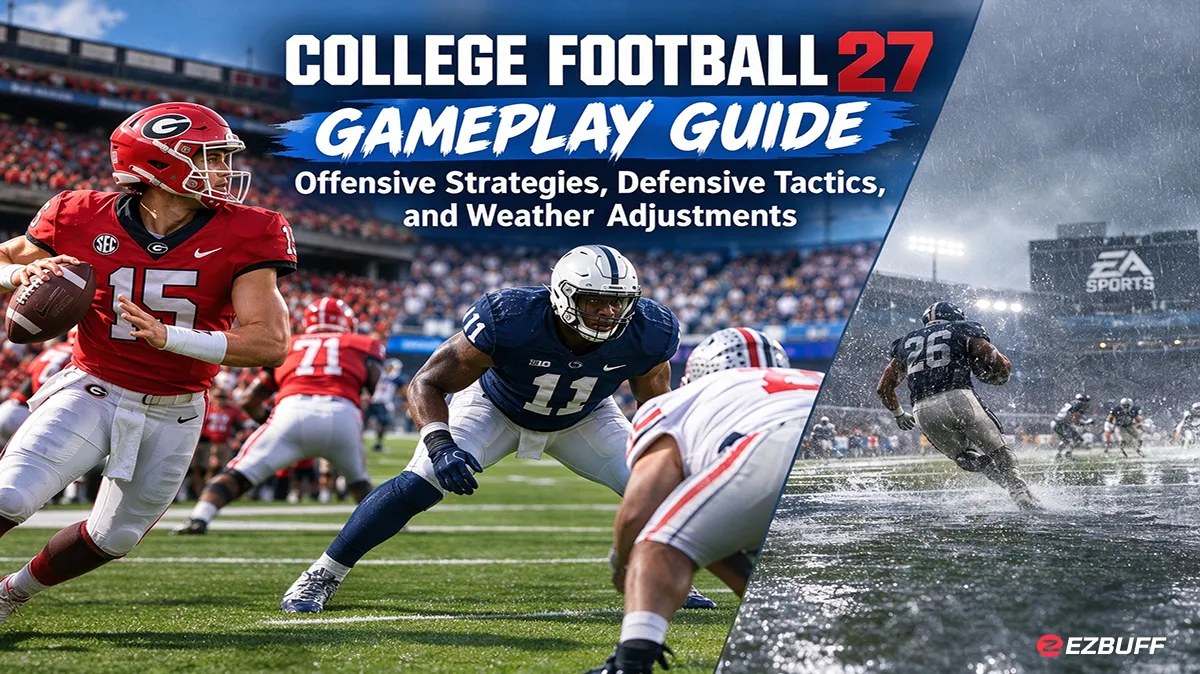
College Football 27 requires more than choosing a strong team and executing familiar plays. Players need to read defensive formations, recognize offensive opportunities, manage the clock, and adjust their tactics as the game develops. A well-balanced strategy can make a significant difference, especially when facing opponents who adapt quickly or exploit predictable play-calling.
For beginners, the most effective approach is to learn a small number of reliable offensive and defensive plays before expanding into more advanced tactics. Understanding how passing, running, coverage schemes, and weather conditions interact will help you make better decisions throughout each matchup.
1. Offensive Gameplay: Balance Passing and Running Plays
Offensive success starts before the ball is snapped. Players must evaluate the defensive formation, identify potential weaknesses, and select a play that fits the situation. Repeating the same approach makes an offense easier to predict, so maintaining a balance between passing and running is essential.
Short Passing: Build Consistent Yardage
Short passes are useful when the defense leaves underneath routes available or positions defenders deep to prevent explosive plays. Quick throws can help maintain possession, move the chains, and reduce the amount of time the quarterback holds the ball.
Beginners should focus on identifying open receivers and releasing the ball promptly. Forcing a throw into tight coverage can turn a routine possession into an interception. Short passing is particularly valuable when the offense needs a manageable gain rather than a risky play.
Medium and Long Passing: Create Big-Play Opportunities
Intermediate and deep passes can produce substantial yardage, but they require better timing and defensive awareness. Before attempting a long throw, check whether the intended receiver has separation and whether a safety is positioned to cover the route.
Players should also consider down and distance. A deep pass may be appropriate when trailing late in the game, but it is often unnecessary when a shorter completion can secure a first down. Developing patience and recognizing passing windows will make the offense more efficient over time.
Running Plays: Control the Clock and Reduce Risk
Running plays provide another way to move the ball while controlling the pace of a game. They can be especially useful when the defense emphasizes pass coverage or when the offense wants to protect a lead.
However, running directly into a crowded defensive front can result in minimal gains. Look for opportunities created by favorable blocking, open lanes, and defensive alignment. Alternating inside runs with outside runs can also make the offense less predictable.
2. Defensive Strategies: Read Formations and Control Space
Defense is not simply about rushing the quarterback as quickly as possible. Players must identify likely offensive intentions, protect important areas of the field, and prevent receivers from finding uncontested passing lanes.
Man Coverage: Match Defenders With Receivers
Man coverage assigns defenders to specific offensive players. This approach can be effective when a defender has the speed and coverage ability to keep pace with the assigned receiver.
Before selecting man coverage, consider the opponent's strongest receiving threats and the quality of your defensive matchups. If a receiver consistently creates separation, relying on the same assignment may expose the defense to repeated big plays.
Zone Coverage: Protect Key Areas
Zone coverage assigns defenders responsibility for designated sections of the field rather than individual receivers. It can provide a stable foundation for beginners because defenders work together to limit passing opportunities.
Nevertheless, zone defense requires awareness of the spaces between coverage areas. Experienced opponents may target underneath openings or exploit gaps between defenders. Watch how the offense attacks your coverage and adjust your positioning or play selection when necessary.
Pass Rush: Pressure the Quarterback Without Losing Coverage
Generating pressure can force hurried throws, disrupt passing timing, and create opportunities for sacks or turnovers. However, sending too many defenders forward can leave fewer players available to cover receivers.
A disciplined pass rush balances pressure with protection behind the defensive line. Instead of choosing aggressive pressure on every play, consider the situation, the opponent's passing tendencies, and the amount of time available for the offense to operate.
3. Dynamic Weather: Adapt to Changing Conditions
Weather can add another layer of uncertainty to football games. When conditions deteriorate, including situations involving heavier snowfall, players should be prepared to reconsider their usual strategies rather than relying entirely on a standard game plan.
Prioritize Familiar Plays in Difficult Conditions
Unfamiliar or timing-sensitive plays can become harder to execute when conditions are unfavorable. Players should lean on offensive formations and routes they understand well, particularly when possession and field position are more important than a high-risk attempt.
Reassess Passing Risk
When passing becomes less reliable, forcing long throws may create unnecessary turnovers. Consider shorter routes, safer completions, and running plays when the defensive alignment allows them.
The objective is not to abandon the passing game completely, but to evaluate whether the potential reward justifies the risk in a particular situation.
Adjust to the Opponent's Response
Weather adjustments should affect both offense and defense. If the opponent begins relying more heavily on running plays, prepare to protect against the run. If they continue attempting difficult passes, focus on coverage discipline and capitalize on mistakes when opportunities arise.
Successful players remain flexible without changing their entire strategy after every unsuccessful play.
4. Beginner Tips: Build a More Consistent Game Plan
New players can improve more quickly by concentrating on a few fundamentals:
- Learn several dependable offensive plays and understand when each is appropriate.
- Read defensive formations before choosing between a pass and a run.
- Avoid forcing throws into crowded coverage.
- Use zone coverage as a starting point while learning how opponents attack different areas.
- Balance quarterback pressure with receiver coverage.
- Monitor the clock, score, and down-and-distance situation before taking risks.
- Review unsuccessful plays to identify whether the problem came from play selection, timing, or defensive recognition.
Consistency is more valuable than constantly experimenting with complicated tactics. Once these fundamentals become familiar, players can gradually introduce more specialized formations and situational strategies.
5. College Football 27 Coins and Team Progression
Building a competitive team involves more than mastering individual plays. Roster decisions, player development, and resource management can also influence how effectively a team performs over time.
College Football 27 Coins may be relevant to a player's resource planning, depending on the game's supported economy and progression systems. Before spending resources, identify the positions or upgrades that would make the greatest difference to your preferred playstyle. An offense built around passing may prioritize different player attributes from a team that relies heavily on running.
Players researching how to Buy College Football 27 Coins should first verify the available purchasing options, platform compatibility, and applicable game rules. It is also important to use legitimate channels and understand the risks associated with unauthorized transactions.
A sensible resource plan focuses on addressing genuine roster needs instead of spending impulsively. Combined with disciplined play-calling, sound defensive decisions, and effective weather adjustments, thoughtful team management can help players develop a more consistent approach to College Football 27.
Ultimately, success comes from recognizing what the situation demands. Balance your offense, defend space intelligently, adapt when conditions change, and make roster decisions that support your preferred style of play.
