


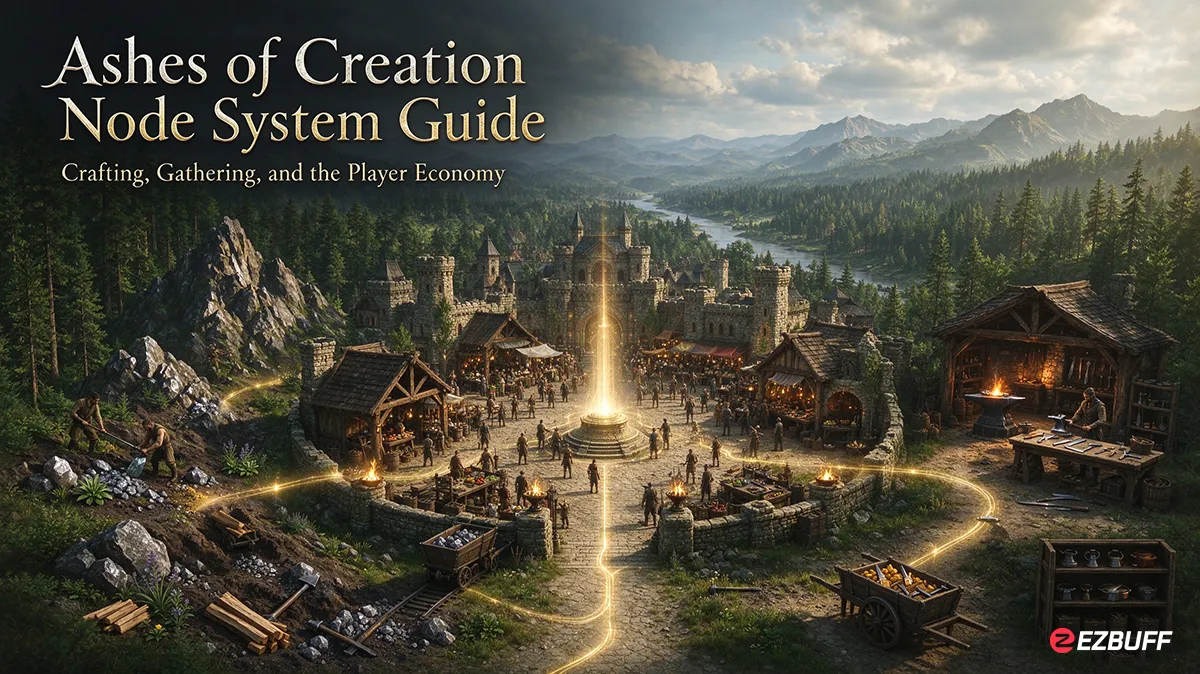
Ashes of Creation attracted attention for its ambition to make the game world respond to player activity. Its original design connected regional development with exploration, gathering, crafting, trading, and community participation.
For players interested in sandbox MMORPGs, the Node system and player-driven economy are especially important concepts to understand. They were intended to connect individual activities with the development of settlements and the movement of resources throughout the world.
This guide examines how these systems were designed to interact, why economic awareness matters, and what players should verify before relying on older gameplay information.
1. What Is the Node System?
The Node system was designed to allow regions of Verra to develop through player activity. As players participated in activities within an area, a Node could progress and eventually unlock additional services and content.
More developed Nodes were intended to become important destinations for players. Their facilities, social structures, and surrounding opportunities could influence where people gathered and how they interacted with the world.
This approach offered a different perspective on MMORPG progression. A settlement's importance would not depend solely on a fixed story or a predetermined city layout. Instead, player activity was intended to influence how the world evolved.
The system also created potential competition between regions, making settlement development relevant to players interested in trade, exploration, and organized group activities.
2. Gathering: Understanding the Value of Resources
Gathering was intended to supply the raw materials needed by the wider crafting economy. Resources could support equipment production, processing activities, and other forms of player-driven commerce.
A useful economic principle is that a material's value depends on more than its rarity. Its practical applications, production requirements, availability, and demand all influence how valuable it may be.
Players studying Ashes of Creation's original gathering design should consider three questions:
- What can the resource be used to produce?
- How difficult is it to obtain compared with alternative materials?
- What factors could increase or reduce demand for the finished product?
These questions help explain the logic behind resource-based economies and provide a foundation for evaluating crafting systems in other MMORPGs.
However, historical descriptions should not be interpreted as confirmation that specific resources or gathering activities are currently accessible.
3. Crafting and Production Planning
Crafting connects raw materials with the items players need. In the original Ashes of Creation concept, this relationship was intended to give gathering and production a meaningful role in the wider economy.
Successful production planning requires an understanding of material costs, the usefulness of the finished item, and the availability of alternative sources. A crafted item may be valuable because it is useful, difficult to produce, or in demand among other players.
Players should also distinguish between collecting resources and turning those resources into useful goods. Gathering can provide materials, but crafting adds another layer of planning and specialization.
The most efficient economic strategy depends on the actual rules, recipes, and market conditions available in a given game build. Without a verified playable environment, precise profitability claims would be unreliable.
4. How Player Trading Can Influence an MMORPG Economy
Player-driven trading creates relationships between producers, consumers, and resource suppliers. When a popular activity requires specific materials, demand may increase. When more players supply those materials, prices may respond.
This relationship between supply and demand is one reason economic systems attract players who enjoy planning and optimization.
Readers searching for Buy Ashes of Creation Gold should first understand how the game's currency and trading systems were intended to support these activities. It is important to distinguish the general concept of an MMORPG economy from the present availability of any particular currency or transaction service.
Before considering a currency-related purchase, verify that the game is operating, that the relevant economic systems are accessible, and that the proposed service is legitimate and permitted.
5. Why Regional Development Matters to Trade
The Node system was intended to connect economic activity with geography. As regions developed, they could become more important destinations for players, creating potential changes in demand, resource movement, and community activity.
This design could encourage players to think beyond individual transactions. A region's development might influence where people gathered, which services they used, and what kinds of resources became important.
For guilds and organized communities, these relationships could create strategic decisions about where to establish a presence and how to coordinate production and trading activities.
The broader lesson is that an MMORPG economy does not operate independently of its world. Geography, player behavior, production systems, and settlement development can all contribute to economic change.
6. Researching Ashes of Creation Economic Guides
When reading older Ashes of Creation guides, check whether the information describes a proposed feature, a historical test build, or a verified current system.
Intrepid Studios' reported closure in February 2026 makes this distinction especially important. Earlier design documents and gameplay discussions can explain the project's ambitions, but they do not establish current server availability or active development.
EZBUFF readers researching MMORPG economies should prioritize clearly sourced information and avoid relying on outdated currency prices, crafting recipes, or trading instructions.
The Node system and player-driven economy remain useful subjects for understanding Ashes of Creation's original vision. Before making purchasing decisions, however, confirm the project's operational status and the availability of any related services.
By understanding how gathering, crafting, trading, and regional development were intended to work together, readers can better evaluate the game's design without confusing historical mechanics with current functionality.
