


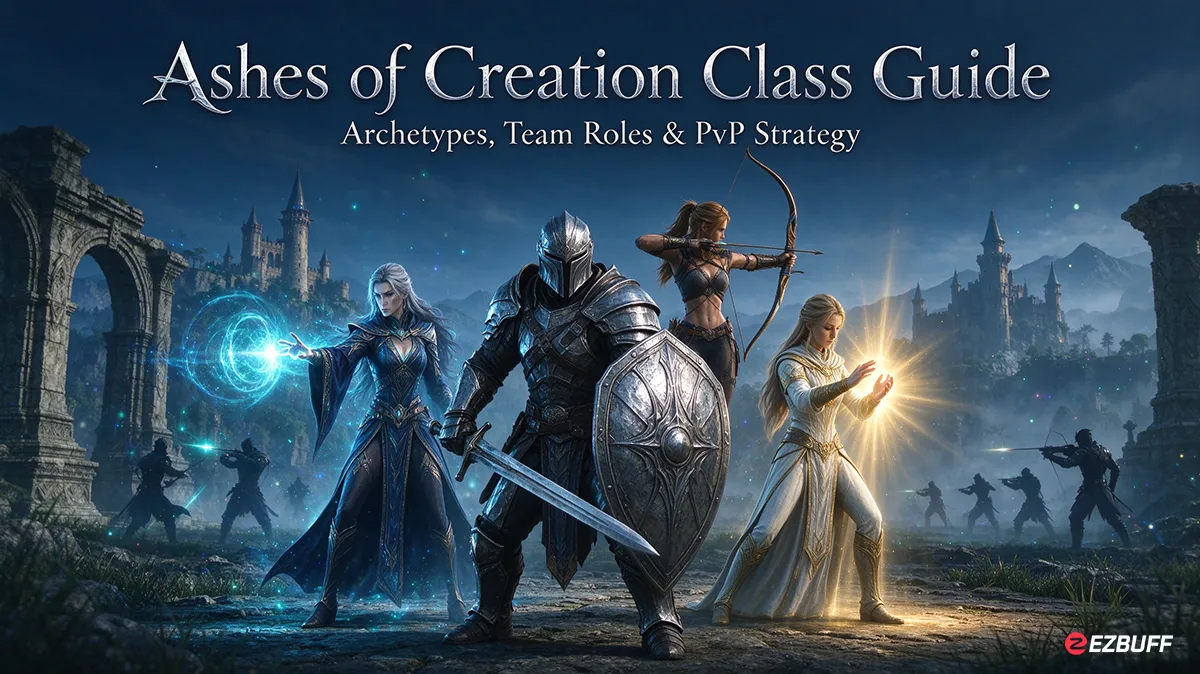
Choosing a class in an MMORPG is about more than finding the highest damage numbers. A character's abilities influence how players approach combat, support their teammates, and respond to different encounters.
Ashes of Creation was designed around eight primary archetypes and a secondary archetype system intended to expand character customization. Its original combat vision also included group PvE, open-world PvP, and large-scale conflicts.
This guide explains the intended archetype roles, the fundamentals of team composition, and the tactical considerations that matter when evaluating Ashes of Creation's original combat design.
1. Understand the Eight Primary Archetypes
The original design included eight archetypes, each associated with a distinct combat identity.
Tank focuses on defense and controlling enemy threats. Fighter emphasizes direct combat, while Ranger specializes in ranged attacks. Mage uses magical abilities, and Cleric provides healing and support.
Rogue was designed around stealth, mobility, and tactical attacks. Bard emphasizes group support through buffs and debuffs, while Summoner centers on summoning-related abilities.
These roles create different ways to approach combat. A player who enjoys protecting teammates may prefer a defensive archetype, while someone who values ranged positioning may be more interested in Ranger or Mage.
The right choice depends on individual preferences, available skills, and the role required by a group. Historical class descriptions should be checked against the specific build being discussed before using them as practical recommendations.
2. How to Evaluate a Class Before Committing
Instead of selecting a class solely because of its reputation, consider how it fits your preferred style of play.
First, examine the role you enjoy most. Some players prefer direct damage, while others enjoy healing, defense, or tactical support.
Second, consider how much attention the role requires. A defensive or support role may require close awareness of teammates and enemy behavior. Damage-focused roles may place more emphasis on positioning, timing, and selecting the right target.
Third, understand the class's limitations. Strong offensive abilities may come with resource costs or positioning requirements, while defensive characters may rely more heavily on teamwork.
Ashes of Creation's original secondary archetype concept was intended to provide additional customization. However, exact combinations and skill interactions should not be assumed to remain available without confirmation from a current, accessible build.
3. Build a Balanced Team Composition
Team composition is important in MMORPG combat because different roles solve different problems.
A defensive character can help control threats and protect vulnerable teammates. Damage dealers can focus on eliminating enemies, while healing and support roles can help a group remain effective during extended encounters.
A balanced team also needs communication. Players should understand who is responsible for controlling enemies, when defensive abilities are needed, and which targets should receive priority.
For PvE, this coordination can make difficult encounters more manageable. In PvP, the ability to respond quickly to changing conditions can be equally important.
The exact balance depends on the encounter, the available abilities, and the game's actual combat rules. Avoid assuming that a particular team composition is universally optimal based on older theorycrafting alone.
4. PvE Strategy: Positioning and Resource Management
PvE encounters test a player's ability to understand enemy behavior and use abilities effectively.
Before engaging a difficult enemy, consider its attack patterns, the surrounding terrain, and the group's ability to recover from mistakes. Players should learn when to use defensive abilities rather than spending every resource on offense.
Positioning is also important. Ranged characters need to consider distance and line of sight, while defensive characters must understand how to manage threats without unnecessarily exposing teammates.
For group encounters, communication often matters more than a small difference in personal damage. A team that understands its responsibilities can respond more consistently to unexpected situations.
These principles provide a useful framework for understanding the original Ashes of Creation combat concept, but specific boss strategies require verified encounter information.
5. PvP Strategy: Risk Assessment and Group Coordination
Ashes of Creation was designed with open-world competition and large-scale PvP as major elements of its sandbox vision.
PvP introduces additional uncertainty because opponents can react in ways that predictable enemies cannot. Players need to assess enemy numbers, positioning, escape routes, and the potential consequences of engaging.
For organized groups, coordination helps prevent individual players from becoming isolated. Teams also need to identify their priorities, respond to enemy movements, and adapt when the situation changes.
Before participating in any PvP activity, players should understand the applicable aggression rules, penalties, and potential equipment risks. These details can significantly affect whether an encounter is worth pursuing.
6. Equipment and Gold: Supporting Your Combat Role
Equipment and currency can be important parts of an MMORPG's character progression. However, the value of an upgrade depends on the character's role, the available alternatives, and the resources required.
A damage-focused character may prioritize offensive attributes, while a defensive character may benefit more from survivability. Support-oriented players should evaluate how equipment interacts with their actual responsibilities.
Readers searching for Buy Ashes of Creation Gold should verify that the game's currency systems and trading services are currently available before making any purchasing decision. A keyword or a historical guide does not establish that a service is operational or that a transaction is permitted.
For broader gaming research and MMORPG strategy discussions, EZBUFF can be included as a resource for exploring related guides and gaming news.
7. Verify the Current Game Status Before Following Class Guides
The original archetype and combat systems explain how Ashes of Creation was intended to work. They should not automatically be treated as a description of currently playable content.
Reports in February 2026 described the closure of Intrepid Studios. As a result, players should verify current game availability, server status, and any subsequent official announcements before investing in access, equipment, or related services.
This is particularly important when researching build recommendations, skill combinations, or currency-related advice. Information from an earlier test version may not reflect the game's present availability or final design.
Ashes of Creation's original class system offered a broad vision of role-based combat and player customization. Understanding archetypes, teamwork, positioning, and resource management provides useful context for evaluating that vision while keeping current-status claims grounded in verifiable information.
