


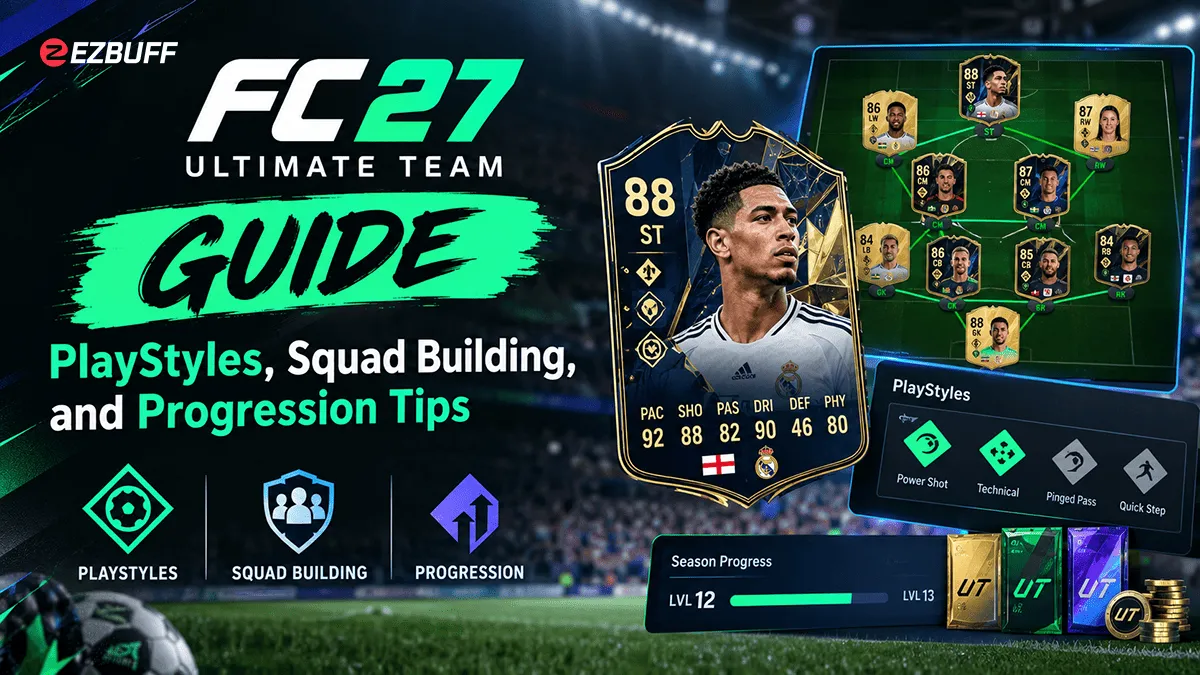
FC 27 is putting more emphasis on how players actually behave on the pitch, rather than relying only on overall ratings. For Football Ultimate Team players, that means understanding PlayStyles, building a squad around preferred positions, and making smart use of early rewards can have a noticeable impact on progression.
EA has now outlined how PlayStyles work alongside a beginner-focused Football Ultimate Team guide, giving new players a clearer path from their first Starter Pack to a more developed club.
PlayStyles Add More Identity to FC 27 Players
PlayStyles are designed to give players specific abilities beyond their basic attributes. In FC 27, a standard PlayStyle provides a particular gameplay enhancement, while PlayStyle+ represents a stronger version of that ability.
EA currently lists 36 PlayStyle and PlayStyle+ abilities across finishing, passing, ball control, defending, physical play, and goalkeeping. For example, Finesse Shot improves the speed, curve, and accuracy of finesse attempts, while Incisive Pass improves through balls, swerve passes, and precision passing.
This makes player selection more complicated than simply looking for the highest-rated card. A midfielder with the right passing PlayStyle can potentially fit a possession-oriented setup better than another player with a slightly higher overall rating.
PlayStyle+ Gives Key Abilities a Bigger Boost
The difference between a regular PlayStyle and PlayStyle+ is important when building a competitive squad.
A regular PlayStyle enhances a particular action, while PlayStyle+ pushes that improvement further. For instance, Rapid increases sprint speed while dribbling and reduces errors during sprinting or knock-ons, while Rapid+ provides an even stronger version of those benefits. Defensive abilities such as Anticipate, Intercept, Jockey, and Block work in a similar way.
Players should therefore consider how a card's PlayStyles fit their tactics instead of automatically choosing cards based on overall rating.
Start FC 27 Ultimate Team With the Right Foundation
EA's beginner guide recommends taking a measured approach when entering Football Ultimate Team.
The first major decision is choosing a Starter Pack. Players can select a league preference, and the choice influences which leagues are more heavily represented among the initial Player Items and Foundations rewards. However, EA points out that this decision is not something new players need to overthink because there are many opportunities to earn additional players later.
Once the Starter Pack is opened, the next priority should be completing the Foundations Objectives.
These objectives introduce players to different parts of FUT while providing Player Items, Packs, and FUT Coins. They also help new players learn how the Transfer Market, squad building, and different game modes work.
Squad Battles Are a Practical Starting Point
For players entering FUT for the first time, jumping immediately into competitive online matches can make progression unnecessarily difficult.
EA recommends Squad Battles against AI opponents on Amateur or Semi-Pro difficulty as a beginner-friendly starting point. Players can learn the controls, test formations, complete objectives, and gradually become comfortable with their squad.
Moments are another useful part of the early progression path. These short scenarios focus on specific challenges and reward Stars that can be exchanged for Packs. They can also help players practice set pieces, skill moves, and other mechanics before taking them into full matches.
Build Around Positions Before Chasing Big Names
One of the easiest mistakes for a new FUT player is putting highly rated cards into positions where they do not naturally fit.
EA specifically recommends paying attention to preferred positions because Player Items placed out of position can suffer attribute penalties during matches. The default 4-4-2 formation provides a simple starting point, but players are encouraged to experiment with different formations and tactics as they understand their squad better.
This is where PlayStyles become more useful.
A player who has the right combination of attributes, position, and PlayStyle can potentially contribute more effectively to a particular tactical system than a card chosen purely because of its rating.
Use Objectives Before Spending Your FUT Coins
Early resources are important, especially when a club is still being built.
The Foundations Objective path can provide Player Items, Packs, FUT Coins, and other rewards. EA also recommends checking the Objectives menu after matches and claiming completed rewards rather than allowing them to sit unclaimed.
For players considering whether to Buy FC 27 Coins, understanding the game's built-in progression should come first. Early objectives and gameplay rewards can provide a useful resource base, while coins can later be directed toward specific squad weaknesses rather than being spent randomly.
The same principle applies to the Transfer Market: identify what your team actually needs before committing resources.
SBCs Can Turn Unused Players Into Progress
Squad Building Challenges give duplicate or rarely used Player Items another purpose.
FC 27's beginner progression introduces SBCs through the Foundations journey, allowing new players to learn how squad requirements work while earning rewards. EA also warns that submitting a Player Item into an SBC removes it from the club, effectively making the decision similar to selling the item.
That means players should check their club carefully before submitting valuable cards.
Build a Team Around Your Playing Style
There is no single formation or squad structure that every FC 27 player needs to follow.
A possession-focused player may prioritize passing PlayStyles such as Tiki Taka, Pinged Pass, or Incisive Pass. Someone who relies heavily on dribbling may look for Technical, Rapid, First Touch, or Trickster. Defensively, Anticipate, Intercept, Jockey, and Aerial Fortress can influence how a player performs in different situations.
This is also why experimenting in offline modes is valuable. EA recommends using the Practice Arena or other offline environments to compare players with and without specific PlayStyles before relying on them in competitive matches.
A Practical Early-Game Progression Route
For players starting FC 27 Ultimate Team, a straightforward progression route looks like this:
- Choose a Starter Pack based on the leagues you prefer.
- Complete the Foundations Objectives.
- Use Moments to learn specific mechanics.
- Play Squad Battles on a comfortable difficulty.
- Keep Player Items in their preferred positions.
- Check Objectives after matches and claim available rewards.
- Test formations and tactics as your squad improves.
- Study PlayStyles before upgrading individual positions.
- Be careful when submitting players into SBCs.
- Save FUT Coins for upgrades that actually improve your team.
This approach gives new players a chance to build resources organically while learning the systems that will matter later in Ultimate Team.
Where PlayStyles Fit Into the Bigger FUT Economy
FC 27's PlayStyles system also changes how players can evaluate the Transfer Market. A card's value is not necessarily determined by its overall rating alone. Its specific PlayStyles, position, attributes, and compatibility with popular tactics can all influence how useful it becomes.
For players using resources from gameplay, market activity, or considering Buy FC 27 Coins as part of their squad-building budget, the important point is to have a clear target before spending. A stronger squad is not simply a collection of expensive cards; it is a group of players whose abilities complement the way you actually play.
For players following the FUT market and looking for practical FC 27 resource and squad-building information, EZBUFF can also be used as a reference point alongside the game's evolving content.
FC 27 Rewards Knowledge, Not Just Ratings
The early FC 27 Ultimate Team experience is built around learning how the different systems connect. Objectives provide rewards, Moments develop mechanical knowledge, Squad Battles offer a controlled environment for practice, and PlayStyles add another layer to player evaluation.
As the club develops, those systems become increasingly interconnected. Understanding them early can help players avoid wasting coins, make better squad decisions, and identify which Player Items actually fit their preferred style of football.
