


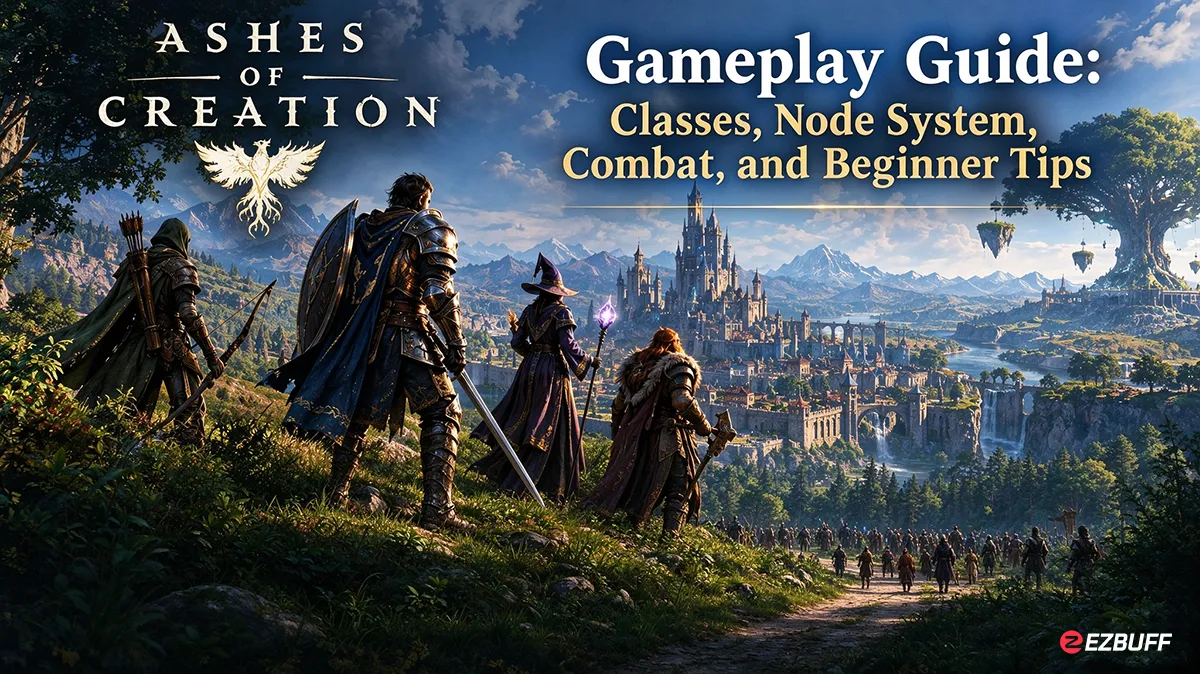
Ashes of Creation was designed to offer a different kind of MMORPG experience, combining open-world exploration, class customization, player-driven economies, and settlements that evolve through community activity. Instead of following a completely fixed world progression, players were intended to influence the development of Verra through combat, gathering, crafting, trading, and political competition.
This Ashes of Creation gameplay guide explains the game's original core systems, the eight archetypes, beginner progression strategies, and the role of Node development. It also covers the project's current status so readers can distinguish its original gameplay vision from what is presently available.
1. Explore Verra and Understand the Open World
Exploration is one of the central ideas behind Ashes of Creation. Verra was designed as a fantasy world containing different biomes, settlements, dangerous creatures, hidden locations, and valuable resources.
For new players, learning the surrounding environment would be an important first step. Understanding enemy locations, travel routes, gathering opportunities, and nearby settlements helps players make better decisions about where to spend their time.
Rather than rushing into dangerous areas, beginners should first become familiar with combat controls, equipment management, and basic survival mechanics. In an MMORPG built around open-world competition, preparation can make a significant difference.
2. Choose the Right Archetype for Your Playstyle
Ashes of Creation was designed around eight primary archetypes. Each archetype represents a different combat role, while the secondary archetype system was intended to provide additional customization.
The original archetypes include:
- Tank: Focuses on defense, enemy control, and protecting allies.
- Fighter: Specializes in direct combat and melee damage.
- Ranger: Uses ranged attacks and positioning to control engagements.
- Mage: Relies on magical abilities and area damage.
- Cleric: Provides healing and defensive support.
- Rogue: Emphasizes mobility, stealth, and burst damage.
- Bard: Supports allies through buffs, debuffs, and group utility.
- Summoner: Uses summoning abilities as part of a customizable combat style.
There is no single archetype that suits every player. Those who enjoy group content may prefer a defensive or support role, while players who favor independent combat may gravitate toward damage-focused options.
Before choosing a class combination in any available build, check the relevant skill descriptions and balance information. The original design does not guarantee that every planned ability or combination remains accessible.
3. Understand the Node System
The Node system was one of Ashes of Creation's defining features. It was designed to make the world react to player activity rather than relying entirely on predetermined settlement development.
As players participated in activities around a region, their collective actions could contribute to that area's progression. More developed Nodes were intended to unlock additional services, quests, facilities, and opportunities for social organization.
Node development also had broader consequences. Settlements could become centers of commerce, attract more players, and influence competition between neighboring regions.
For players interested in the game's original sandbox vision, this system explains why exploration and community participation were meant to matter beyond individual character progression.
4. Combat, PvE, and PvP Strategies
Combat was designed to support both player-versus-environment encounters and player-versus-player competition.
PvE: Monsters, Bosses, and Group Content
PvE encounters reward players for understanding enemy behavior, managing resources, and coordinating with teammates. Tanks can help control threats, Clerics can support group survival, and damage dealers can focus on eliminating enemies efficiently.
Beginners should prioritize learning skill rotations and defensive abilities before attempting difficult encounters. Better positioning and resource management can be just as important as equipment.
PvP: Open-World Competition and Sieges
PvP was another major part of the original design, including open-world encounters, caravan-related activities, and large-scale territorial conflicts.
Players considering these systems should understand the risks before engaging. Enemy numbers, terrain, escape routes, and the rules governing player aggression can all influence the outcome of an encounter.
Group coordination is especially important in large battles. A team that communicates effectively and understands its members' roles can respond more efficiently than a group that relies entirely on individual damage.
5. Gathering, Crafting, and the Player-Driven Economy
Ashes of Creation aimed to connect resource gathering, processing, crafting, and trading into a player-driven economy.
Raw materials could serve as inputs for production, while crafted equipment and other goods could meet the needs of other players. In a system like this, an item's value depends not only on its usefulness but also on supply, demand, production costs, and regional activity.
For players exploring this original economic design, three principles are particularly relevant:
- Understand what resources are used for before spending time collecting them.
- Compare material costs with the value of the finished product.
- Consider how settlement development and player activity could affect demand.
These principles are useful for understanding the intended gameplay loop, but current market availability and trading functionality should not be assumed.
Understanding the in-game economy is an important part of learning Ashes of Creation's original gameplay design. Players were expected to gather resources, craft useful equipment, and trade goods based on supply and demand. Those researching terms such as Buy Ashes of Creation Gold should first understand how the game's currency, trading systems, and economic mechanics were intended to work. Before considering any currency-related service, verify that the game and its relevant systems are currently operational and review the applicable rules.
6. Beginner Progression: What Should You Learn First?
A sensible learning order for Ashes of Creation's original systems would be:
- Learn the combat controls, basic skills, and equipment interface.
- Choose an archetype that matches your preferred role.
- Explore nearby areas and understand enemy difficulty.
- Learn how gathering, crafting, and trading were intended to interact.
- Study Node progression and its effects on the surrounding world.
- Find a community or group to learn more about coordinated PvE and PvP.
This approach helps new players understand how the game's systems were designed to connect. However, it should be treated as a conceptual learning path rather than a guarantee of playable progression in the current state of the project.
For more MMORPG guides, progression advice, and gaming news, readers can also explore EZBUFF. When researching Ashes of Creation, focus on verified game information, understand the relationship between gathering and crafting, and check current availability before making decisions about character progression or in-game purchases.
7. Ashes of Creation Development Status: What Players Should Know
There is an important distinction between the game's original ambitions and its current situation.
In February 2026, Game Developer reported that Intrepid Studios had shut down, with a California WARN notice confirming the permanent closure and the loss of 123 jobs. Steam's current store information and older development descriptions do not, by themselves, establish that the game is receiving active development or that its servers remain operational.
Before attempting to access the game, purchasing a key, or spending money on related services, readers should verify current availability and any official updates. Do not assume that previously documented features, servers, or progression systems are still accessible.
Final Advice
Ashes of Creation was built around an ambitious MMORPG concept: a changing world, customizable combat roles, player-driven economies, and settlements shaped by collective activity. Understanding these systems helps explain what made the project distinctive.
For anyone researching Ashes of Creation gameplay, classes, or the Node system, the key is to separate the original design from verified current functionality. Check the project's status before investing money or planning a new character, and use historical guides as background information rather than assuming they describe a functioning live game.
